.jpg)



International Students
- International Students
- Policy of Non-affiliation—Equal treatment of All International Students
- Proof of English Language Proficiency
- Time Required for Pilot Training
- The Real Cost of Pilot Training
- How to Begin the Application Process
- Processing Application Fee
- E-mail Communication
- Admission to Canada
- Working in Canada while you Study
- Custodianship
- Do we have to wear a uniform?
- Questions regarding Pilot Training
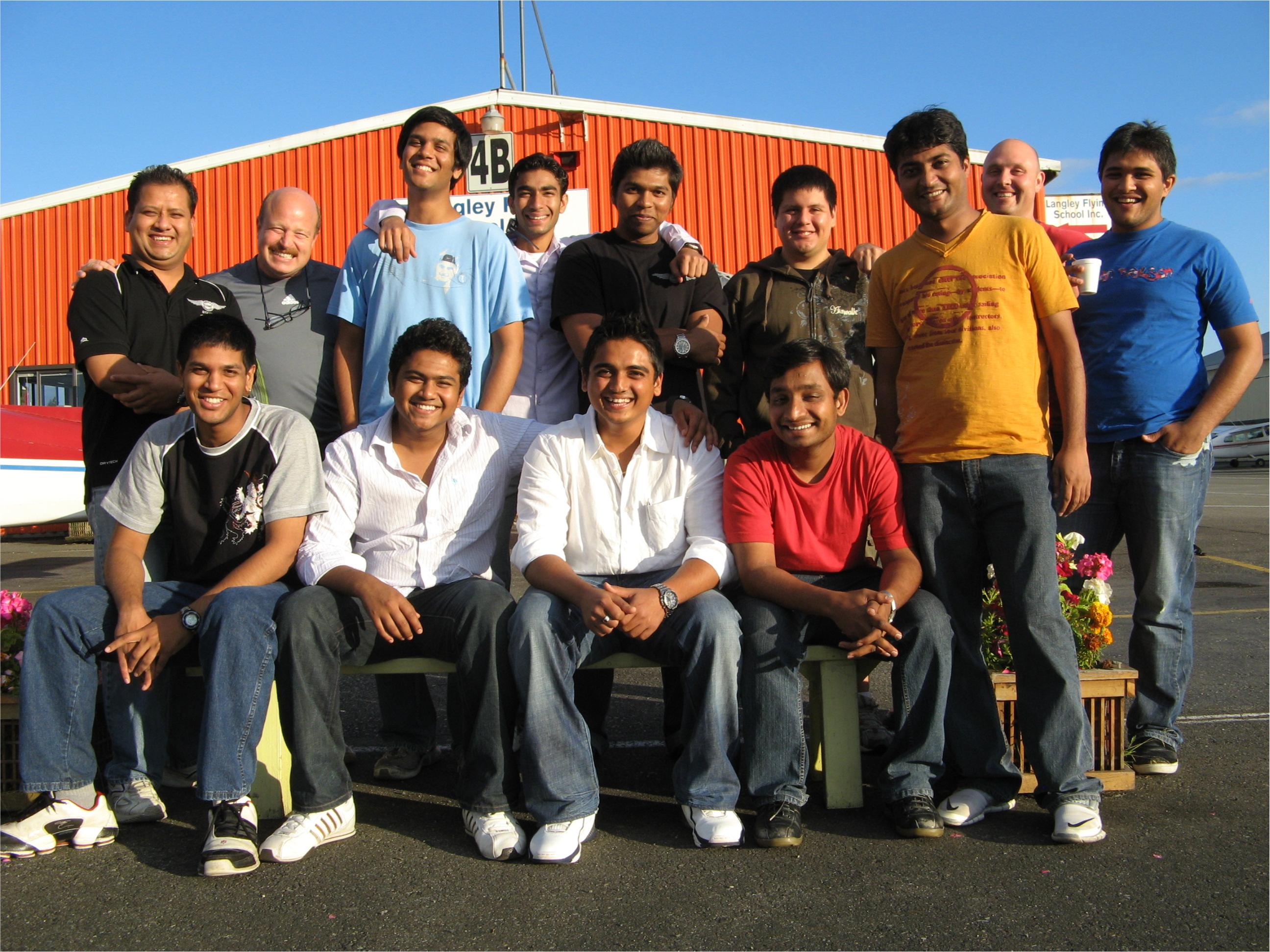
Thank you for visiting the Langley Flying School website. We appreciate your interest in our School, and we hope be able to welcome you one day as one of our International Students.
If you are not a Canadian Citizen (perminent resident) with a proof of conducting high school in Canada, you will need a student visa to start your learning.
For Chinese students, please contact our Chinese students department infochina@langleyflyingschool.com for more information.
For other international students, please contact administration@langleyflyingschool.com for more information.
Importantly, please note important changes that have occurred in our application process and requirements—we have attempted to reduce the financial burden faced by international student in their initial application, and we have also refined our $500 International Student Bursary that is awarded to international students upon completion of the initial Private Pilot Licence. These changes our discussed below in the Processing Application Fee section.
One of the great pleasures we have as Flight Instructors is the opportunity to teach students from all over the world who come to Canada to learn to fly; some of them—perhaps yourself—land at our School, and it is with great pride that we get to send them back to their homes and families as fully qualified professional pilots.
Canada's pilot licences and ratings—and especially the Canadian Commercial Licence—are top ranked throughout the world, owing to the reputation of the Canadian licence holders for solid pilot skills, thorough yet practical pilot knowledge, and safe and effective pilot decision-making. The history of international flight training in Canada goes back to the 1940s with the Commonwealth Air Training Plan, and it is pride and conviction that we—like many other private flying schools located throughout Canada—are able to continue with the tradition of providing effective and proven pilot training programs for international students.
Policy of Non-affiliation—Equal treatment of All International Students
Langley Flying School is committed to the fair and equitable treatment of all of its International Student. All International Students are treated fairly and equally, and Langley Flying School seeks to minimize the cost of training in all cases. International Students are fully integrated with Langley Flying School's domestic students.
Proof of English Language Proficiency
Applicants must meet the English requirement prior to be accepted. To get more information with the english requirement, please contact anniewu@langleyflyingschool.com.
Time Required for Pilot Training
With respect to time-line, you should know that the Private Pilot Licence—pursued on a full-time basis—can be completed in as little as six weeks, but normally requires between three and six months, depending on student performance (time required before students' first solo flight commonly varies between 10 and 30 hours, depending on performance skills). Completion of the Commercial Pilot Licence typically requires an additional six to eight months. To complete these licences along these time-lines, International Students will have to fly daily. The same programs will take a year or more if the training pace is less than full-time.
While completion of the Commercial Pilot Licence requires the longest time, the Multi-engine Class Rating and the Instrument Rating are the shortest—the Multi-engine Class Rating requires only about three weeks, and the Instrument Rating is just a little longer—about four to six weeks.
Critical in your understanding of pilot training completion times is the fact that training is performance-based—students must successfully complete qualifying Transport Canada flight tests and written examinations, and student performanced—especially during Private Pilot Licence training and preparaton--varies tremendously.
The Real Cost of Pilot Training
It would be great if we could predict with accuracy just how long (and therefore how much money) the pilot licences and rating training will take, but unfortunately, student performance varies considerably, especially during the Private Pilot phase of training. Transport Canada regulations require that Flight Instructors cannot recommend students for flight tests or written examinations until they meet the standards established by Transport Canada—Flight Instructors must certify in writing to this affect when the recommendation and application for flight tests or written examinations are submitted to Transport Canada. We can say, however, that full-time students usually complete their Private Pilot Licence at or near the minimum hours required—they are at it daily, and they get good really fast. Please read the Private Pilot Licence course outline carefully regarding performance variations.
In contrast, the Commercial Pilot Licence, Multi-engine Class Rating, and Instrument Rating are reasonably predictable with respect to completion costs—the proficiency of these students is at a higher level, merely because they or more experienced.
All students are advised to keep "cash in reserve" just in case of need for additional pilot proficiency training, especially for students of the Private Pilot Program. Becoming a pilot is a process of reaching the standards of proficiency and knowledge required by Transport Canada and the ICAO, and is not a matter of simply "accumulating flight time." We remind you again to check the cost section of the individual Pilot Training Programs for additional information. Student pilots do not need the additional pressure of financial worries as they complete their training.
Also, note that students are responsible for the costs of housing and food during training; the "housing" costs estimate provided below is based on what appears to be the average cost of homestay at the date indicated
For setting up a Canadian bank account, information is available from the Royal Bank of Canada.
It goes without saying that all costs are quoted by us in Canadian Dollars, and you can visit the following link to calculate your currency's conversion: Bank of Canada.
How to Begin the Application Process
If you have any questions regarding training, contact the Chief Administrator via email, and I will do our best to provide you with the necessary information. If you have already decided that you wish to join Langley Flying School as a student, complete the Application form and provide the information listed below. PLEASE NOTE that it is crucial that you insure this information is accurate and correct because it is used to complete your Letter of Acceptance, which in turn is used to support your application for your student visa—it must be accurate and correct:
- Your family name (exactly as it appears on your passport).
- Your first name and middle name(s) (exactly as it appears on your passport).
- Your date of birth.
- Your full mailing address (including postal code).
- Your telephone contact number.
- Your proposed starting date.
- The programs you wish to take (e.g., PPL, CPL, IFR, MER).
Processing Application Fee
For International students, our admissions process requires that you must pay the international application fee of $500 and the initial tuition to obtain an LOA.All payments made by International students must be made by Wire Transfer—please contact the Chief Administrator via email to obtain detailed information on how to pay with Wired Transfer.
Once this administrative fee has been paid, and all information regarding the applicant student is receive, we will courier to you the Letter of Acceptance, and this, in turn, will be presented by the applicant student to the Canadian Consulate or Embassy in support of an application for the student visa.
E-mail Communication
The volume of international e-mail inquiries is considerably high at the present; we will try replying to each inqury as soon as possible. To expedite the application process, review the information carefully on this website and follow the suggestions contained on this page. Students who are able to make an independent decision to begin training at Langley Flying School will be processed with little delay.
Admission to Canada
All information related to Canadian student visas can be accessed from a link found on our website (first page under "foreign students") or by visiting the Citizenship and Immigration Canada (CIC) website:
http://www.cic.gc.ca/english/study/index.asp
It is very important that you become familiar with student visa requirements, and you should know that many students are turned down in their applications owing to insufficient funds. The following information related to student qualification appears on the CIC website:
To be eligible to study in Canada:
- You must have been accepted by a school, college, university or other educational institution in Canada.
- You must prove that you have enough money to pay for your:
- tuition fees;
- living expenses for yourself and any family members who come with you to Canada; and
- return transportation for yourself and any family members who come with you to Canada.
- You must be a law-abiding citizen with no criminal record and not be a risk to the security of Canada.
- You may have to provide a police certificate.
- You must be in good health and willing to complete a medical examination, if necessary.
- You must satisfy an immigration officer that you will leave Canada when you have completed your studies.
Source: http://www.cic.gc.ca/english/study/study-who.asp
Working in Canada while you Study
Study permit holders in Canada may gain work experience by working off campus while completing their studies.
Because Langley Flying School is a designated learning institution, our international student qualify to work off campus up to 20 hours per week while completing their studies, subject to the following conditions:
- They work during regular academic sessions or full-time during scheduled breaks;
- They have valid study permits,
- They are full-time students.
For more information, see Langley Flying School Students Working Off-campus.
-
Custodianship
-
If you are an international student under 19, when you apply for a Canadian Study Permit, you might be asked to provide documents showing that you have a custodian in Langley who can help you in case of need. We will assist in making custodianship arrangements for students under 19 who are also staying in a homestay arranged by us. Students under 19 who wish to make their own arrangements for accommodation must also make their own custodianship arrangements. Please note that students under 19 must provide copies of custodianship documents when they first register.
Our Custodianship Criteria
We make available on request an appointed custodian to students who meet all the following criteria:Be a school student registered in full-time studies
Be under the age of 19 (BC requirement)
Have no adult relatives residing in BC
Commit to staying with an appointed host family until their 19th birthday
Appointed a new custodian when departing we appointed host familyThe applicant required a deposit to confirm homestay and custodianship. The payment can be made online. We will prepare the Custodianship Form once the deposit has paid. When the applicant gets the Canadian Study Permit, the deposit will transfer to the Custodian Fee (Non-Refundable).
-
Do we have to wear a uniform?
No, of course not. The dress code of Langley Flying School students and staff are just like any modern Western university or college--casual and comfortable. Our focus as Flight Instructors is teaching student pilots how to fly—we are not interested in teaching student pilots how to wear a tie—we'll leave that to Mums and Dads. Though it is not necessary, if you would prefer to wear a functional flight suit during flight operations, one can be purchased locally for approximately $200 (contact Flight Line)
Questions regarding Pilot Training
After you have reviewed the information on this website concerning the training program and facilities, please to begin an email exchange with me regarding any questions you may have—if I can't personally respond, I will pass your message on to one of our Flight Instructors.
-
Best Regards - Chief Administrator,
- Langley, British Columbia
- Canada