.jpg)



Night Rating Program
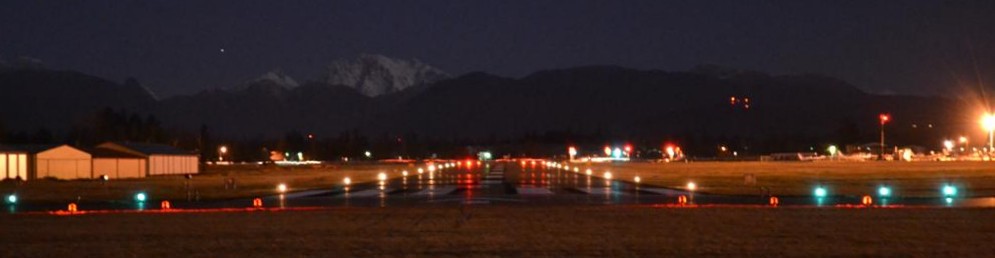
Successful completion of the Night Rating Program leads to eligibility for Night Rating issued by Transport Canada, and the issuance of a Certificate of Qualification—Night Rating by Langley Flying School, Inc. The holder of a licence endorsed with a Night Rating may exercise the privileges of the licence in Night VFR conditions. Credit for the Night Rating may be transferred to Commercial Pilot Program.
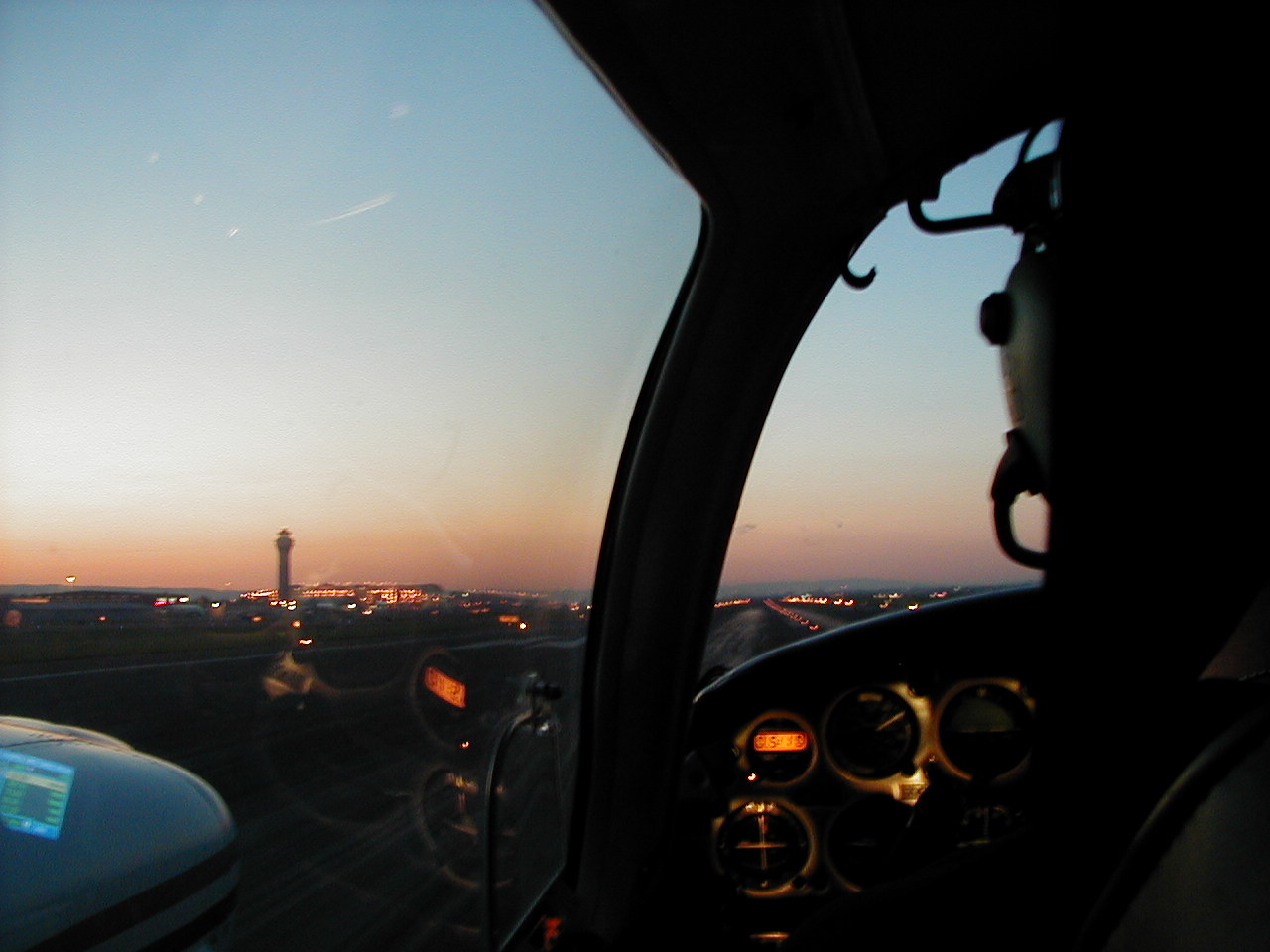
Below: beginning of takeoff roll at Portlad International near the end of civil twilight in Seneca GURW. See second photo below showing the left turn for California.
Prerequisites
The minimum age for a Night Rating is seventeen years of age. Before commencing training in the Night Rating Program, a student requires a valid Private Pilot Licence-Aeroplane Category, and a valid Category 1 or Category 3 Medical Certificate.
Prepayent of fees is not required. Students pay tuition and aircraft unitlizations at the conclusion of training flights, and pay groundschool tuition at the beginning of the session. All flight schools in British Columbia are required by law to charge the GST (5%). Visa, MasterCard, American Express, and Debit Cards are accepted.
Aircraft rates may be subject to change with minimal notice, depending on such things, for example, as fluctuating aviation fuel prices.
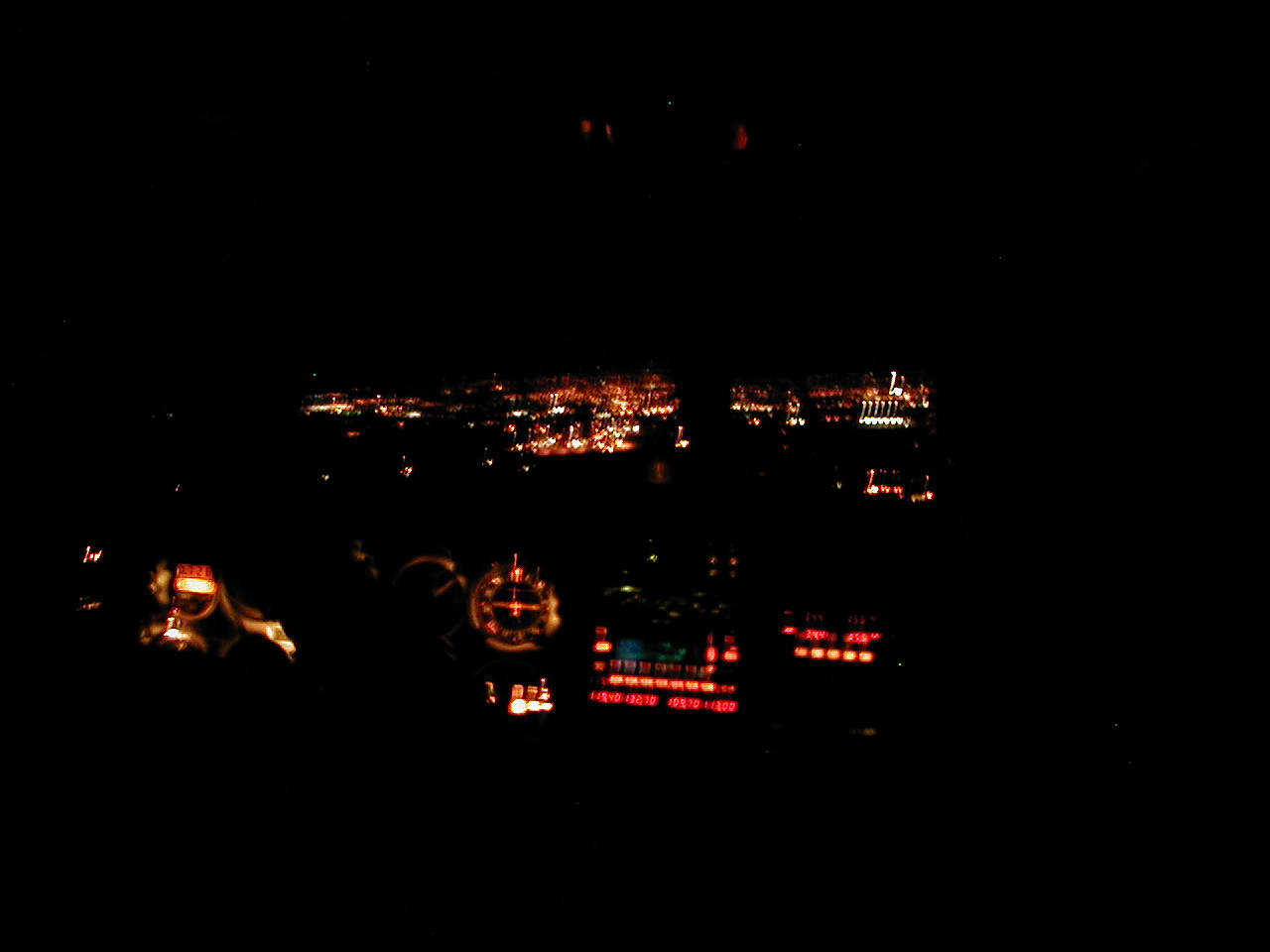
Below: night approach into Abbotsford Airport.
Transport Canada establishes the minimum requirements for the Night Rating as follows:
- 20 hours flight experience in the same aircraft category.
- The applicant must have completed a minimum of 10 hours night-flight experience, including no less than 5 hours dual instruction (which must include a 2-hour cross-country), and 5 hours solo flight time, which must include 10 takeoffs and landings.
- The applicant must also have completed 10 hours dual instrument time.
The exercises practiced for instrument flying concentrate on full panel radio navigation, partial panel compass orientation, and partial panel unusual attitudes. If dual instrument time is flown at night, the difference between dual instrument time and flight time may be logged as dual nighttime.
Below:Captain David's Woollam's photo of northern Saskatchewan from a Piper Seneca.

Air Training Syllabus
Introduction to Partial Panel Instrument Flying—Heading, Altitudes, and Speed Variations
This exercise introduces students to “limited” or “partial” instrument panel flying where, by simulation, the vacuum system failure has occurred and flight-instrument information is limited to that derived from the pitot-static instruments and the turn co-ordinator. This exercise is first flown in the Flight Simulator, and then in the aircraft.
Partial Panel—Timed Turns

When a vacuum failure occurs, the heading indicator can no longer be used for turn information; turn information—simply the heading of the aircraft—must therefore be derived from the compass. The compass, however, is subject to turning errors, making it useless as a means of determining heading while the aircraft is in a banked attitude. Accordingly, changes in aircraft heading, within the context of a failed vacuum system (partial panel), must be accomplished by timing (in seconds) the short intervals at which the aircraft is held in a standard-rate turn. In this exercise students learn organized techniques and procedures for safely and accurately producing specified limited-panel heading changes based on timed turns. This exercise is first flown in the Flight Simulator, and then flown in the aircraft.
Partial Panel—Unusual Attitudes
As the continuation of partial panel instrument training, this exercise focuses on the procedures and techniques for recovering from unusual attitudes using only partial panel flight-instrument information. Training here focuses on partial panel recognition and recovery from impending stalls and spiral dives, as well as fully developed stalls and spins. This exercise is first flown in the Flight Simulator, and then flown in the aircraft, with the pervading goal being to quickly detect or recognize the unusual attitude, and immediately implement pilot inputs necessary to produce a smooth and effective recovery with minimal loss of altitude.
VOR, NDB, and GNNS Position Identification, Intercepts, and Tracking
Students will be introduced to the procedures and techniques required for utilising VOR and NDB navigation aids during instrument flight conditions. Attention will focus on techniques for correct identification of VOR and NDB facilities, and GPS waypoints, determining the position of the aircraft in relation to the VOR, NDB, or waypoint, and applying a systematic procedure to intercept and track specified VOR radials and NDB and waypoint tracks. This exercise is first flown in the Flight Simulator, and then flown in the aircraft.
Night Flying and Circuits
This phase of training introduces students to night VFR operations, and examines such issues as weather factors for night flying, night transitions to and from airports, and other special considerations related to the limited visual reference associated with night flying. Two areas related to pilot skill are emphasized during this phase of night training, the first focusing on upper-air night manoeuvres, and the second revolving around night circuit operations. The upper-air portion seeks to develop general proficiency related to flight manoeuvres at night—including steep turns, slow flight, and “switch back” descending 45° banked turns—and also includes unusual attitude recognition and recovery during both night-VFR and simulated instrument conditions. Students also learn the special considerations associated with executing a forced approach at night—including both off-airport and circuit forced-approach emergencies. Circuit training includes emphasis on the integrated use of flight instruments to establish safe transitions during the departure and approach phases of night flying, and student are trained to conduct landings without a landing light, and without cockpit landings.
Night Cross-country Flight
This exercise has two components. Students first learn how to conduct low-level night navigation using diversion-navigation methods—i.e., unprepared or impromptu navigation without pre-flight preparation. The emphasis here is to develop students’ dead-reckoning skills using the limited landmarks typically encountered during night flying. During the second component of training, students learn to apply radio navigation skills as a supplemental aid to night VFR flying. Training here revolves around a simulated commercial night flight from Langley to Victoria and Nanaimo, during which students learn to use and apply IFR navigation charts, and additionally learn to make effective utilization of ATC radar surveillance services. During the exercise, students receive instruction in determining their position with sole reference to radio navigation aids. Emphasis is placed on examining the requirements for conducting safe night transitions (climbs and descents) during the departure and arrival phases of flight at potentially unfamiliar airports, and students are exposed to the emergency procedure of obtaining radar vectoring when all visual references are lost (inadvertent flight into cloud). This exercise is first flown in the Flight Simulator, and then in the aircraft.
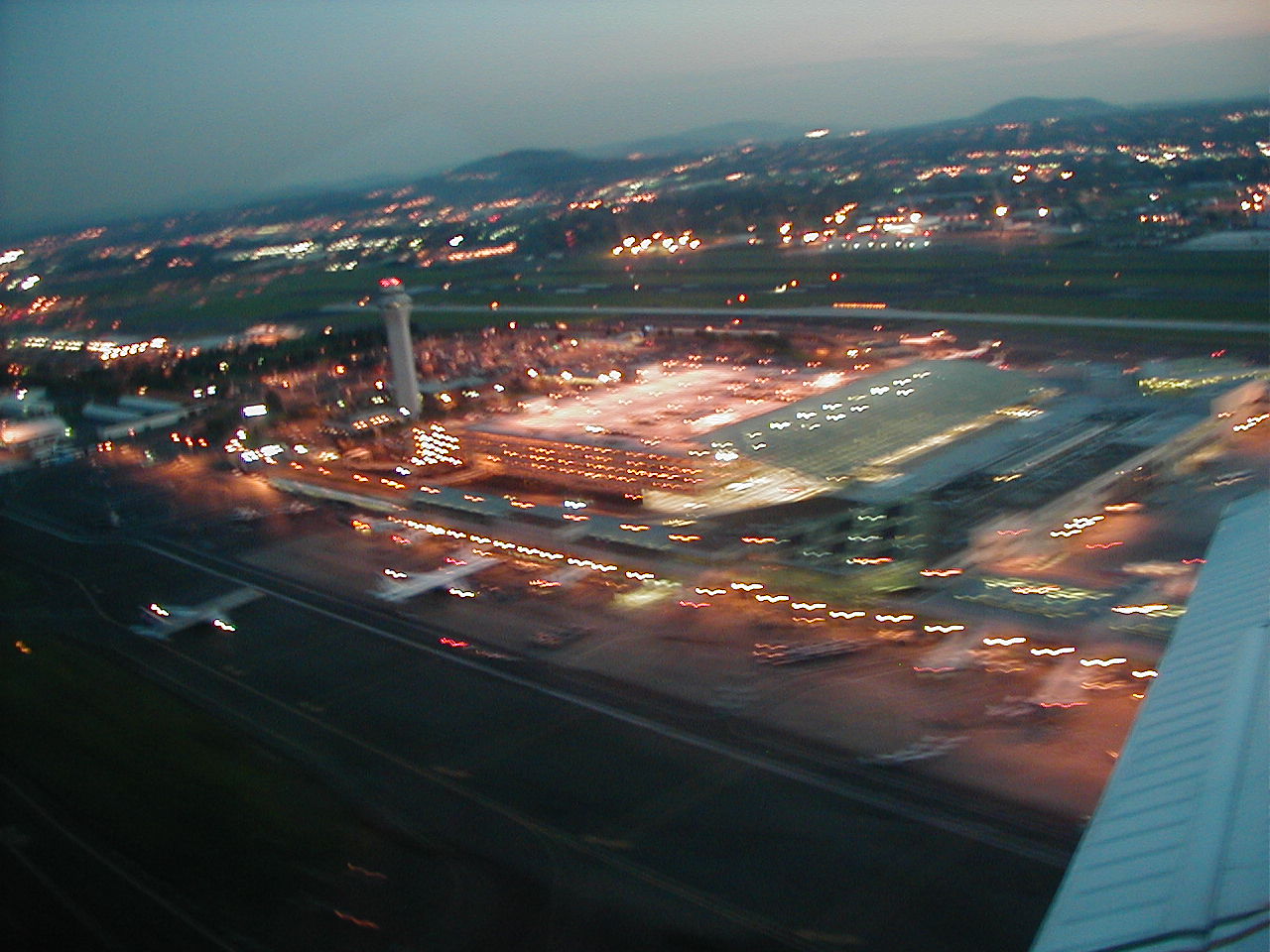
Below: departure turn after takeoff from Portland International Airport, requiring a turn over the main terninal.
Special Considerations for Night Flying
- Night is the period of time in which the sun’s disc is more than 6 degrees below the horizon; for general purpose, it is the time beginning ½ hour after sunset, and ending ½ hour before sunrise.
- Weather briefings prior to flight are critical as weather systems or hazards cannot be seen. During en route phases, obtain updated weather information. Keep an eye out for “disappearing” horizons.
- Charts should always be carefully used to insure sufficient en route ground clearance.
- Airport approaches should always conform to the altitudes depicted in the Obstacle Clearance Circle found in the Canada Flight Supplement.
- Pre-takeoff taxiing should always include rolling instrument check.
- Anti-collision lights should not be used during taxiing, but should be turned on when crossing or entering a runway.
- Always conduct flight operations using the checklists provided in the Pilot Operating Handbook.
- Departure procedures should always include a visual fuel leak check and engine instruments check.
- Always ensure a minimum of 500’ AGL when turning onto final approach, and never make low approaches to landings. It must be assumed that obstacles below the glide path cannot be seen during an approach.
- Taxi carefully.
- Always be prepared to execute a 180° turn on instruments.
- Risk for carburettor ice is greater at night and should be carefully monitored.
- In precipitation, be conscious of airframe icing; monitor ambient temperature and regularly inspect the airframe.
- In addition to the aircraft equipment required for Day VFR flight, Canadian Aviation Regulation 605.16 requires that an aircraft conducting Night VFR be equipped with the following:
-
- a sensitive altimeter adjustable for barometric pressure;
- a turn and slip indicator or turn co-ordinator (or a slip-skid indicator when equipped with a second standby attitude indicator capable of 360 degree attitude indications);
- adequate electrical energy generated for all electrical requirements;
- pilot access to all fuses installed on the aircraft, and spare fuses adequate for at least 50% of fuses installed);
- when operated beyond visual range of an aerodrome, a gyroscopic or stabilized magnetic direction indicator;
- a means of illuminating instruments;
- when carrying passengers, a landing light;
- position and anti-collision lights.
- To fly with passengers at night, the required five takeoffs and landings must have been flown at night within the preceding six months.
- When flying at night, the pilot must have access to a functioning timepiece and a functioning flashlight.