.jpg)



MOUNTAIN FLYING
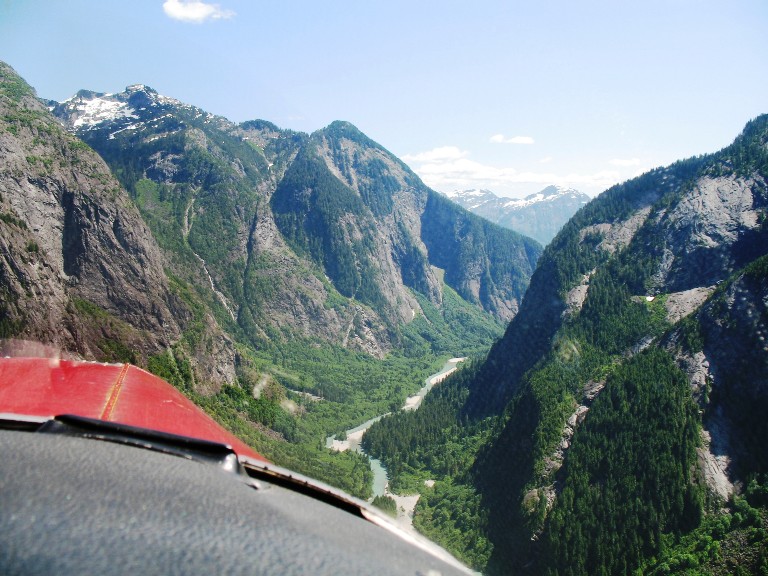
Mountain flying presents high risk. Never fly in the mountains without extensive pre-flight planning and a thorough weather briefing. Here are some rules of thumb derived from Tips on Mountain Flying published by Transport Canada, Aviation Safety:
- Flight routing should be arranged to avoid topography that could prevent a safe landing.
- Flight routing should be along populated areas and well-known mountain passes.
- Sufficient altitude should be maintained at all time so as to enable a power-off glide to a safe landing area.
- VFR Navigation Charts (VNC) should be used rather than World Aeronautical Charts (WAC) as they provide greater detail for air pilotage; the routing, including ground clearances, should be carefully studied before flight.
- When faced with a sea of mountains, believe your compass (bearing in mind compass irregularities) as it may be your only means of getting out of trouble.
- Do not fly when the winds are at or below mountain peak level, or at your intended cruise altitude, are above 30 KTS. Winds above 20 KTS should be avoided.
- In anticipation of possible down drafts, always cross a mountain ridge at a 45° angle so as to allow a turn away from the ridge.
- Know the wind direction at all times, and be on the look out for changes in wind direction and velocity.
- Never fly in the vicinity of abrupt changes in the terrain, such as cliffs or ridges as they can be associated with severe turbulence.
- In anticipation of downdrafts and severe turbulence, cross mountain ridges at maximum altitude, and never with less than 1500’ separation.
- Anticipate downdrafts on the leeward side of mountains, and updrafts on the windward side; anticipate downdrafts between 1500’ and 2000’ per minute.
- Do not panic if a downdraft is encountered; they usually cease with sufficient height above ground that will enable manoeuvring safely away. Do not count on this, however, in extremely turbulent air or in canyon areas.
- If you encounter a severe downdraft, use full power and maintain the best rate of climb speed for the altitude at which you are operating; being cautious of the stall speed, attempt to fly to an updraft or smooth air.
- Remember that the actual horizon is near the base of distant mountains; improperly using the mountain peaks as the horizon will place the aircraft in a slow-flight attitude unable to climb.
- Never fly up the middle of a canyon; instead, fly along one side or the other in case a 180-degree turn is required.
- If possible, fly up the right side of a canyon in anticipation of other aircraft flying in the opposite direction.
- Beware of flying up canyons, valleys, and passes where the rise in terrain could exceed an aircraft climb capability.
- Beware of flying below a cloud ceiling in mountain passes—while the cloud base could be constant, the distance between the cloud base and the ground could decrease owing to rising terrain.
Additional Readings
Transport Canada's Tips of Mountain Flying Part I
Transport Canada's Tips on Mountain Flying Part II
Transport Canada's Looking Back: Flying into a Mountain Trap