.jpg)



Human Factors and Pilot Error
Human Factors denotes the manner in which people relate and interact with their environments. In the case of aviation, the focus is on how pilot performance is influenced or affected by such issues as cockpit design, temperature, altitude, physiology of the body, emotions, interactions, and communications.
Pilot Error is defined as the action or decision of the pilot that, if not caught or corrected, could contribute to the occurrence of an accident or incident, including inaction or indecision.
The Transportation Safety Board of Canada is responsible for investigating all transportation occurrences in Canada, including aviation occurrences. The goal of an aviation safety investigation is to prevent recurrence.
An aviation occurrence is any accident or incident associated with the operation of an aircraft.
A reportable aviation accident is any accident resulting directly from the operation of an aircraft where a person sustains a serious injury or is killed, or an aircraft sustains damage or failure that adversely affects the structural strength, the performance or flight characteristics of an aircraft, resulting in the need for major repair or replacement of any component parts. A missing aircraft is also a reportable accident.
An incident is reportable only if it concerns the operation of an aircraft with a maximum certified takeoff weight of 12500 lbs.1
The actions that must be taken in reporting a “reportable” aviation accident are described in the AIP, GEN 3.3.
It is required that no person displace, move, or interfere with an aircraft involved in an accident, except to extricate persons, or to prevent destruction by fire, or to avoid danger to any person or property.
Accident Rates
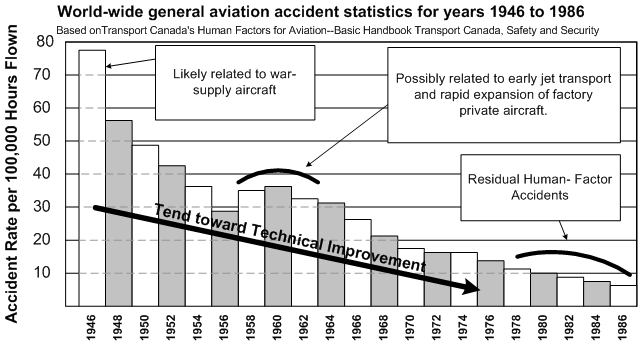
Statistics demonstrate improvement in safety—at least this is the general trend based on records kept since World War II. In 2001, the Canadian accident rate was 7.6 accidents per 100,000 hours flown, and less than 2 fatal accidents per 100,000 hours flown.2 Transport Canada reported for 2001 that there were 167 private aeroplane accidents in Canada, with 17 of these accidents involving fatalities.3 Pilots are generally considered to be the “cause” or “factor” in 84% of all accidents; in fatal accidents, pilot-related cause increases to 90.6%.4
,%20Langley%20Flying%20School.gif)
Accordingly, if a private or recreational pilot has a one-hour flight, once a week, he or she will have to fly for 148 years continuously before an accident is experienced. The same person will have to fly continuously for 1584 years before experiencing a fatal accident.
Exposure to Accident Risk
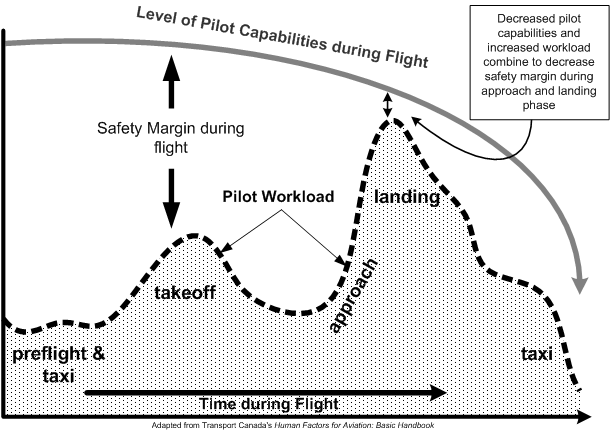
There are two obvious but significant observations here—accidents are most likely to occur during approaches and landings, and it is the landing phase—at the end of the flight—where the workload and fatigue factor are at their maximum.
Consider the depiction below showing what may be described as the normal decrease in safety margin during the course of an average flight.
%20and%20Phase%20of%20Flight,%20Langley%20Flying%20School.gif)
Above is also a table showing the cause of accidents that occurred between 1992 and 2001, relative to the phase of flight, and the first event that gave rise to the accident. The numbers further emphasize the increased exposure to risk associated with takeoffs and landings. Note that the landing risks are associated with events not associated with control or power loss, while these causes are prominent with takeoff accidents. With respect to en route causes, note the significant risk from power loss—be cautious with fuel planning, and be sure to stay current in forced-landing (power-off) skills.
The Accident Pilot Profile
- The pilot involved in the average accident is likely to have the following profile:
- The pilot is likely to be between 35-39 years of age.
- The pilot is likely to have between 100 and 500 hours flying experience.
- The pilot is likely to be on a VFR personal flight.
Experience and Greatest Accident Risk
The highest accident risk for a pilot is:
- 50 hours after receiving Private Pilot Licence;
- 50 to 100 hours after receiving Instrument Rating.
- Here are some reasons that might account for these risk times.
- At the completion of a training program, students have a high level of skill and confidence, but have very little experience.
- Exposure to risk increases rapidly following training, as pilots are no longer in the protective cocoon of the training program where risks are monitored and controlled.
- Despite confidence, new initial pilot or newly rated instrument pilots have not yet developed the experience, knowledge, and skill to recognize and manage the increased risks of IFR flight.
Further Reading:
Transport Canada's Human Factors and Accidents
References
1 The Piper Cherokee, for example, has a maximum certified takeoff weight of 2150 lbs.
2 Transportation Safety Board of Canada’s Statistical Summary—Aviation Occurrences, 2001, P. 1.
3 Ibid., P. 2.
4 Ibid.