.jpg)



CANADIAN AVIATION REGULATIONS PART II
- CANADIAN AVIATION REGULATIONS PART II
- Air Taxi Operations
- Application
- Distribution of Company Operations Manual
- Standard Operating Procedures
- Operational Flight Plan
- Transport of Passengers in Single-engine Aircraft
- Operations over water
- Number of Passengers in Single-engine Aircraft
- Carriage of External Loads
- VFR Flight Obstacle Clearance Requirement
- Minimum VFR Flight Visibility in Uncontrolled Airspace
- VFR Flight Weather Conditions
- VFR OTT Flight
- Routes in Uncontrolled Airspace
- Passenger and Cabin Safety Procedures (CAR 723.38)
- Weight and Balance Control
- Aircraft Equipment Requirements (CARs 703.64 & 69)
- Flight Crewmember Qualifications (CAR 703.88)
- Qualifications Validity Period
- Air Taxi Pilot Proficiency Check (PPC)
- Commuter Operations
- Application
- Distribution of Company Operations Manual
- Standard Operating Procedures
- Information System
- Operational Flight Plan
- Flight Authorization
- Checklist
- VFR Flight Obstacle Clearance Requirement
- VFR Flight Minimum Flight Visibility—Uncontrolled Airspace
- VFR Flight Weather Conditions
- VFR OTT Flight
- Passenger and Cabin Safety Procedures (CAR 704.33)
- Weight and Balance Control
- Take-off Weight Limitations
- En route Limitations with One Engine Inoperative (CAR 704.48)
- Aircraft Equipment Requirements (CAR 704.62)
- Protective Breathing Equipment
- Hand-Held Fire Extinguisher
- Minimum Crew (CAR 704.106)
- Flight Crewmember Qualifications (CAR 704.108)
- Qualifications Validity Period
- Commuter Operations Pilot Proficiency Check (PPC)
- Maximum Duty and Flight Times
Air Taxi Operations
Application
The Air Taxi Operations (ATO) requirements of the CARs apply to any single-engine aircraft, or any multi-engine aircraft, other than a turbo-jet, that has an MCTOW (Maximum Certified Take-off Weight) of 8618 kg (19000 lbs.) or less and a seating configuration of nine or less passenger seats (excluding the pilot seats) (CAR 703.01).
Distribution of Company Operations Manual
The air operator must provide a copy of the company operations manual to all crewmembers, or it must place a copy of the manual in each aircraft operated (CAR 703.106).
Every person who has been provided a copy of the manual is required to keep all amendments up to date, and ensure the manual is accessible during the performance of his or her duties.
Standard Operating Procedures
Where aircraft operations required two or more pilots, the air operator must establish and maintain standard operating procedures that conform with the aircraft flight manual and that include procedures for normal, abnormal and emergency procedures (CAR 703.107).
Operational Flight Plan
An ATO flight cannot commence unless an operational flight plan has been prepared as per the air operator’s company operations manual (CAR 703.01).
A copy of the operational flight plan must be left at the point of departure, and a copy must be retained by the air operator.
The minimum content of an operational flight plan includes routing, altitudes, TAS, IAS, winds, cruise temperature, groundspeed, ETA, distance, fuel burn rate, and signature of Pilot-in-command (CAR 723.18).
Transport of Passengers in Single-engine Aircraft
Unless authorized by the air operator’s certificate, passengers cannot be carried in single-engine aircraft in IFR flight or night VFR flight (CAR 703.22).
Where authorized, to carry passengers single-engine in night VFR or IFR conditions, the aircraft must be equipped in accordance with CAS 723.22, which among other items, must be a factory built, “proven” turbine powered aeroplane, and the aircraft must be equipped with two attitude indicators, two independent power generating sources to sustain essential instrument and electrical equipment, a warning system for excessive ferrous material in the engine lubrication system, a radar altimeter, and a manual throttle system that bypasses the fuel control unit.
Operations over water
Unless authorized by the air operator’s certificate, except during take-off and landing, an air operator cannot operate a land aircraft over water beyond a point where the aircraft could not reach shore in the event of an engine failure (CAR 703.23).
Number of Passengers in Single-engine Aircraft
Unless authorized by the air operator’s certificate, an air operator cannot operate a single-engine aircraft with more than nine passengers on board (CAR 703.23).
Carriage of External Loads
Except where authorized by a type certificate or supplemental type certificate, an air operator cannot carry passengers in an aircraft carrying an external load (CAR 703.25).
VFR Flight Obstacle Clearance Requirement
Except when conducting takeoffs or landings, an aircraft in VFR flight at night cannot operate at less than 1000 feet above the highest obstacle located within a horizontal distance of three miles from the route to be flown, and during the day (in the case of aircraft) not less than 300 feet AGL or above any obstacle within a 300- foot horizontal distance (CAR 703.27).
Minimum VFR Flight Visibility in Uncontrolled Airspace
While within uncontrolled airspace, an aircraft can only operate in day VFR conditions at or below 1000 feet with less than two miles flight visibility when authorized to do so by the air operator certificate (CAR 703.28).
To do so the aircraft must also be equipped with the following functional equipment: artificial horizon, directional gyro or gyrocompass, and a GPS navigation receiver.
The pilot must be experienced (500hrs. in Part VII (commercial) operations), and must have specified training, and the aircraft’s airspeed must be reduced for the purpose of obstacle avoidance.
VFR Flight Weather Conditions
VFR flight is prohibited unless current weather reports and forecasts indicate that the weather conditions along the route to be flown and at the destination aerodrome “will be such that the flight can be conducted in compliance with VFR” (CAR 703.29).
VFR OTT Flight
VFR OTT operations can only be undertaken when authorized to do so in the air operator certificate (CAR 703.33).
Routes in Uncontrolled Airspace
IFR or night VFR flight in uncontrolled airspace cannot be conducted along a route other than an air route unless the air operator establishes the route in accordance with the following:
- a MOCA must be established for each route segment whereby, during IFR flight a minimum altitude of 2000 feet is maintained above the highest obstacle located within a horizontal distance of 10 miles from the route centre line, or in night VFR a minimum of 1000 feet is maintained above the highest obstacle located within 3 miles of the route centre line;
- for each route segment an MEA is established which meets or exceeds the MOCA and assures navigational coverage;
- the air operator maintains a record of the company routes;
- where the routes are based on non-public navigation aids, the accuracy of the signal can be verified;
- the company operations manual outlines procedures for signal verification;
- and night VFR flight visibility is not less than three miles (CAR 703.34).
Passenger and Cabin Safety Procedures (CAR 723.38)
With regard to the movement of air taxi passengers to and from an aircraft, the follow procedures must be followed:
a)wherever possible, aeroplanes are parked in a location that avoids passenger exposure to hazardous conditions;
b)passengers are alerted to hazardous conditions;
c)guidance, and where necessary an escort, to ensure passengers are directed along a safe route to or from the aeroplane;
d)smoking restrictions are enforced;
e)personal headsets that are used with personal entertainment systems that decrease awareness of other traffic or limit reception of audible direction or warning signals are not worn;
f)passengers are briefed on how to safely emplane and deplane when aircraft engines are running; and
g)passengers on float planes are alerted to hazards unique to emplaning and deplaning these aircraft.
When an aircraft is being refuelled with air taxi passengers on board, or with passengers embarking or disembarking, the following procedures must be followed:
a)the pilot supervises the fuelling and remains near the aeroplane main exit to immediately communicate with and assist the evacuation of passengers in an emergency;
b)all exits are clear of obstruction and available for passenger evacuation;
c)the aeroplane engines are not running unless the aircraft incorporates a propeller brake and the brake is set. Procedures must be included in the Aircraft Flight Manual for the use of the prop brake while refuelling;
d)electrical power supplies are not being connected or disconnected, and any equipment likely to produce sparks or arcs is not being used;
e)smoking is not permitted in the aeroplane or in the vicinity of the aeroplane;
f)fuelling is suspended when there are lightning discharges within 8 km of the aerodrome;
g)combustion heaters in the aeroplane or in the vicinity of the aeroplane are not operated;
h)known high energy equipment such as High Frequency (HF) radios and weather-mapping radar are not operated, unless in accordance with the aeroplane manufacturer's approved flight manual where the manual contains procedures for the use of this equipment during fuelling; and
i)photographic equipment is not used within 10 feet (3 meters) of the fuelling equipment or the fill or vent points of the aeroplane fuel systems.
Weight and Balance Control
An aircraft cannot be operated unless, for every phase of the flight, the load restrictions, weight and centre of gravity of the aircraft is in conformity with the limitations specified in the Pilot Operating Handbook (CAR 703.37[1]).
The weight and balance system used must meet the standards of accuracy.
The company operations manual must specify the weight and balance system and instructions on accurate preparation.
The weight and balance computation may be incorporated into the operational flight plan.
Initial and recurrent training must be provided to staff.
Aircraft Equipment Requirements (CARs 703.64 & 69)
It is prohibited to operate a multi-engine aircraft with passengers on board in IMC unless the aircraft is equipped with the following:
- a power failure warning device or vacuum indicator to show the power available for gyroscopic instruments from each power source;
- an alternate source of static pressure for the altimeter and the airspeed and vertical speed indicators;
- two generators, each of which is driven by a separate engine or by a rotor drive train;
- two independent sources of energy, at least one of which is an engine-driven pump or generator, and each of which is able to drive all gyroscopic instruments and is installed so that the failure of one instrument or one source of energy will affect neither the energy supply to the remaining instruments nor the other source of energy.
No person shall operate an aircraft at night unless the aircraft is equipped with at least one landing light.
No person shall operate an aircraft unless the pilot seat and any other seat beside the pilot seat is equipped with a safety belt that includes a shoulder harness.
Flight Crewmember Qualifications (CAR 703.88)
No person may act as flight crewmember unless:
- the person holds the licence and ratings required by Part IV (Personnel Licensing) of the CARs;
- within the previous 90 days the person has completed at least three takeoffs and three landings
- where a type rating for that aircraft is required, in a same type or in an approved simulator;
- where a type rating is not required, in that category and class;
- the person has successfully completed a pilot proficiency check or competency check, the validity period of which has not expired, in accordance with the following:
- in the case of the Pilot-in-command of a multi-engine aircraft or single-engine aeroplane that is operated in accordance with Subsection 703.22(2), a pilot proficiency check for the type of aircraft;
- in the case of Second-in-command of a multi-engine aircraft, a pilot proficiency check or a competency check for the type of aircraft;
- in the case of the Pilot-in-command of single-engine aeroplanes that is not operated in accordance with Subsection 703.22(2), a competency check for the type of aircraft:
- has fulfilled the requirements of the air operator’s ground and flight training program.
To act as Pilot-in-command of an aircraft in night VFR with persons on board other than a flight crewmember, the Pilot-in-command must have an instrument rating for the class of aircraft.
No person shall act as Pilot-in-command with passengers on board unless he or she has acquired the following flight times on “that type and basic model of aircraft”:
-
- five hours Pilot-in-command in the case of single-engine aeroplanes;
- fifteen hours Pilot-in-command in the case of multi-engine aeroplanes.
The times above (time on type and basic model) can be reduced by one hour for each take-off and landing completed, up to a maximum of 50%; as well, the above does not apply with respect to training, ferrying or positioning flights.
Qualifications Validity Period
The validity period for pilot proficiencyand pilot competency checks is 12 months (identical to the renewal format of medical certificates) (CAR 703.91).
If the proficiency check, competency check, or annual training is renewed within the last 90 days of its validity period, the validity period is extended 12 months.
If not renewed within 24 months of expired validity, the person must re-qualify.
Air Taxi Pilot Proficiency Check (PPC)
Note: the material Air Taxi Pilot Proficiency Check (PPC) below is for information purposes only and does not constitute part of the material required for student knowledge.
- Pre-flight Phase
- Flight Planning and Equipment Examination
- Flight planning shall include a practical examination on the pilot's knowledge of standard operating procedures and the Aeroplane Flight Manual including performance charts, loading, weight and balance and Flight Manual Supplements; and
- The equipment examination shall show a practical knowledge of the airframe, engine, major components and systems including the normal, abnormal, alternate and emergency operating procedures and limitations relating thereto.
- Aeroplane Inspection
- A pre-flight aeroplane inspection that includes:
- a visual inspection of the exterior and interior of the aeroplane, locating each item to be inspected and explaining the purpose of the inspection;
- the proper use of the pre-start, start and pre-taxi check lists; and
- checks of the appropriate radio communications, navigation and electronic equipment and selection of the appropriate communications and navigation frequencies prior to flight.
- A pre-flight aeroplane inspection that includes:
- Flight Planning and Equipment Examination
- Flight Phase
- Taxiing
- taxiing procedures including, where appropriate, sailing and docking procedures;
- a taxiing check including:
- the use of the taxiing check list;
- taxiing in compliance with clearances and instructions issued by the appropriate air traffic control unit or by the person conducting the pilot proficiency check; and
- where a second-in-command is undergoing the pilot proficiency check, outlined above to the extent practicable from the second-in-command position.
- Engine Checks
- Taxiing
Engine checks shall be conducted as appropriate to the aeroplane type.
- Take-off
- One normal take-off to be performed in accordance with the Airplane Flight Manual;
- An instrument take-off performed in the same manner as the normal take-off except that instrument flight rules are simulated at or before reaching an altitude of 200 feet above the airport elevation. Not required to be demonstrated where the Air Operator’s Certificate authorizes operations under day VFR only, or the air operator assigns the pilot to day VFR flight only;
- Where practicable under existing meteorological, airport or airport traffic conditions, one crosswind take-off performed in accordance with the aeroplane operating manual where applicable;
NOTE: Any or all of the above takeoffs may be combined.
- a simulated engine failure after take-off as follows:
- where performed in a visual synthetic training device, the simulated failure of the critical engine shall occur at the take-off safety speed plus 10 kts; or
- where performed in an aeroplane in flight, at a safe altitude as close to the take-off safety speed plus 10 kts as is safe and appropriate to the aeroplane type under the prevailing conditions; and
- a rejected take-off:
- performed in a Level A synthetic flight training device prior to reaching lift-off speed; or
- explained by the candidate prior to the flight where the pilot proficiency check is conducted in an aeroplane.
- Instrument Procedures
Except where an Air Operator Certificate authorizes operation under day VFR only, or an operator assigns the pilot to day VFR flight only, instrument procedures shall consist of IFR pre-flight preparation, departure and en route procedures, terminal procedures and system malfunctions.
- An area departure and an area arrival procedure shall be performed where the pilot:
- adheres to actual or simulated air traffic control clearances and instructions; and
- properly uses the available navigation facilities;
- holding procedures;
- at least two instrument approaches performed in accordance with procedures and limitations in the Canada Air Pilot or in the equivalent foreign publications, or approved company approach procedure for the approach facility used. Where practicable one of the approaches shall be a precision approach and one a non-precision approach; and
- a circling approach except where local conditions beyond the control of the pilot prevent a circling approach from being performed.
- In Flight Manoeuvres
- At least one steep turn in each direction with a bank angle of 45° and a change in heading of at least 180° but not more than 360°.
- Approaches to stalls
For the purpose of this manoeuvre the required approach to a stall is reached when there is a perceptible buffet or other response to the initial stall entry. When performed in an aeroplane the approach to stalls shall be conducted at an altitude of at least 5000 feet AGL, and if conducted above cloud at an altitude of at least 2000 feet above the cloud tops.
The following approaches to the stall are required during initial and upgrade PPCs:
- one in the take-off configuration, except where a zero-flap take-off configuration is normally used in that model and type of aeroplane;
- one in a clean configuration; and
- one in a landing configuration.
One of the approaches to stall shall be performed while in a turn with a bank angle of between 15° and 30°.
- Landings and Approaches to Landings
- one normal landing which shall, where practicable, be conducted without external or internal glideslope information;
- one landing from an instrument approach, and where prevailing conditions prevent an actual landing, an approach to a point where a landing could have been made. Not required to be demonstrated where the Air Operator’s Certificate authorizes operations under day VFR only, or the air operator assigns the pilot to day VFR flights only;
- one cross wind landing where practicable under existing meteorological, airport and airport traffic conditions;
- one landing and manoeuvring to that landing with a simulated failure of 50 percent of the available engines; and
- one landing under simulated circling approach conditions except that where prevailing conditions prevent a landing, an approach to a point where a landing could have been made.
NOTE: Any of the landings and approaches to landings specified in this section may be combined. A minimum of two landings are required.
- Normal Procedures
The pilot shall demonstrate or show knowledge of as many of the normal procedures as the person conducting the check finds are necessary to determine that the pilot has the knowledge and ability to properly use installed equipment. The demonstration of these procedures may be combined with in-flight manoeuvres. The following are examples of areas that may be examined:
- anti-icing and de-icing systems;
- auto-pilot systems;
- automatic or other approach aid systems;
- stall warning devices, stall avoidance devices, and stability augmentation system;
- airborne radar devices; and
- other systems, devices, or aids.
- Abnormal and Emergency Procedures
The pilot shall demonstrate the use of as many of the abnormal and emergency procedures as is necessary to confirm that the pilot has an adequate knowledge and ability to perform these procedures.
System malfunctions shall consist of a selection adequate to determine that the pilot has satisfactory knowledge and ability to safely handle malfunctions.
At least two simulated engine failures any time during the check.
Commuter Operations
Application
The Commuter Operation requirements apply to
- multi-engine aircraft that has a MCTOW (Maximum Certified Take-off Weight) of 8618 kg (19000 lbs.) or less and a seating configuration of 10 to 19 passenger seats (excluding the pilot seats); or,
- turbo-jet-powered aircraft having a maximum zero fuel weight of 22680 kg (50000 pounds) or less authorized by way of a Canadian type certificate to transport not more than 19 passengers (CAR 704.01).
Distribution of Company Operations Manual
The Commuter Operator must provide a copy of the company operations manual to all crewmembers, or it must place a copy of the manual in each aircraft operated (CAR 704.122).
Every person who has been provided a copy of the manual is required to keep all amendments up to date, and ensure the manual is accessible during the performance of his or her duties.
Standard Operating Procedures
Where aircraft operations required two or more pilots, the air operator must establish and maintain standard operating procedures that conform with the aircraft Pilot Operating Handbook and that include procedures for normal, abnormal and emergency procedures (CAR 704.124).
Information System
Every Commuter Operator must create and maintain a system for the timely dissemination of informationand a means by which crewmembers acknowledge receipt of such information
(CAR 704.13).
Operational Flight Plan
A Commuter flight cannot commence unless an operational flight plan has been prepared as per the air operator’s company operations manual.
A copy of the operational flight plan must be left at the point of departure, a second copy must be retained on board the aircraft until the final destination is reached, and a third copy must be retained by the operator.
The minimum content of the operational flight plan includes routing, altitudes, TAS, IAS, winds, cruise temperature, groundspeed, ETA, distance, fuel burn rate, and signature of Pilot-in-command (CAR 724.17).
Flight Authorization
A person cannot commence a flight unless the flight has been authorized as per the procedures specified in the company operations manual (CAR 704.18).
Checklist
The operator must establish specified checklists (CAR 602.60[1][a]) for each aircraft, and the checklist must be followed (CAR 704.19).
VFR Flight Obstacle Clearance Requirement
Except when conducting take-offs or landings, an aircraft in VFR flight at night cannot operate at less than 1000 feet above the highest obstacle located within a horizontal distance of three miles from the route to be flown, and during the day (in the case of aircraft) not less than 500 feet AGL or above any obstacle within a 500 foot horizontal distance (CAR 704.23).
VFR Flight Minimum Flight Visibility—Uncontrolled Airspace
Applicable only to Helicopters (CAR 704.24).
VFR Flight Weather Conditions
VFR Flight is prohibited unless current weather reports and forecasts indicate that the weather conditions along the route to be flown and at the destination aerodrome “will be such that the flight can be conducted in compliance with VFR” (CAR 704.25).
VFR OTT Flight
VFR OTT in aeroplanes is prohibited (CAR 704.28) unless authorization is provided in the air operator certificate, and the flight is conducted under conditions allowing for descent under VMC, or continuation of the flight under Vmc if its critical engine fails (CAS 724.28) .
Passenger and Cabin Safety Procedures (CAR 704.33)
With regard to the movement of commuter passengers to and from an aircraft, the follow procedures must be followed:
- wherever possible, aeroplanes are parked in a location that avoids passenger exposure to hazardous conditions;
- announcements to embarking/debarking passengers as warranted to alert them to hazardous conditions or dangers that may be encountered during embarkment/disembarkment and/or enroute to or from the airside exit/entrance points, and advising them to follow any directions provided outside the aeroplane;
- adequate guidance, and where necessary an escort, provided to passengers so as to ensure that their movements while airside are properly controlled. The responsibility for this shall be clearly defined and the controls shall ensure:
- passengers are directed along the correct and safe route between the aeroplane and the airside entrance/exit point, and prompt attention is given to stragglers where necessary;
- an escort is assigned to control passenger movements when the route to or from the aeroplane is congested by other aircraft or vehicles or when required by the Air Carrier Security Measures; and
- passengers are not exposed to hazards from aircraft operations, fuelling equipment, exposure to jet blasts, engines, rotors or propellers, or to the hazards posed by lighting conditions, obstacles positioned along the route or unsafe surface or stairway conditions;
- smoking restrictions are enforced;
- personal headsets that are used with personal entertainment systems that decrease awareness of other traffic or limit reception of audible direction or warning signals, are not worn;
- clearly assigning the responsibility for the opening/closing and the locking/unlocking of terminal building doors, to enable enplaning/deplaning passengers to access the apron or terminal. Where this responsibility is assigned to persons other than the air operator's personnel or those contracted by the air operator, the crew members are so advised;
- where conditions so warrant, the embarking/disembarking activity is postponed until a safe walking zone is prepared;
- unsatisfactory or hazardous conditions are reported to the responsible authority;
- passengers are briefed on how to safely emplane or deplane whenever the aircraft engines are running; and
- passengers on float planes are alerted to hazards unique to emplaning and deplaning this type of aircraft.
When an aircraft is being refuelled with commuter passengers on board, or with passengers embarking or disembarking, the following procedures must be followed:
- in order to ensure that crew members receive prompt notification of a situation threatening safety such as major fuel spill or a fire, two way communication is maintained between the ground crew supervising the fuelling and the qualified personnel on board the aeroplane so that the aeroplane can be disembarked or evacuated as necessary;
- a means of communication among the qualified personnel on board the aeroplane, ground/maintenance crews and fuelling agencies is determined and established and the procedures are provided to the appropriate personnel;
- the aeroplane engines are not running unless the aircraft incorporates a propeller brake and the brake is set. The Aircraft Flight Manual must refer to the propeller brake/engine as an auxiliary power unit (APU);
- during the fuelling process:
- aeroplane ground power generators or other electrical ground power supplies are not being connected or disconnected;
- combustion heaters installed on the aeroplane (e.g. wing and tail surface heaters, integral cabin heaters) are not operated;
- other combustion heaters used in the vicinity of the aeroplane are manufactured to CSA or ULC standards and approved in accordance with the Fire Commissioner of Canada for use in hazardous atmosphere;
- known high energy equipment such as High Frequency (HF) radios are not operated, unless in accordance with the aeroplane manufacturer's approved flight manual where the manual contains procedures for the use of this equipment during fuelling;
- weather-mapping radar equipment in the aeroplane is not operated unless in accordance with the manufacturer's approved aeroplane flight manual where the manual contains procedures for use during fuelling;
- aeroplane batteries are not being removed or installed;
- external battery chargers are not being connected, operated or disconnected;
- aeroplane-borne auxiliary power units which have an efflux discharging into the zone are not started after filler caps are removed or fuelling connections are made;
- if an auxiliary power unit (APU) is stopped for any reason during fuelling it shall not be restarted until the flow of fuel has ceased and there is no risk of igniting fuel vapours, however, the APU may be operated in accordance with the manufacturer's approved aeroplane flight manual if the manual contains procedures for starting the APU during fuelling;
- electric tools or similar tools likely to produce sparks or arcs are not being used; and
- photographic equipment is not used within 10 ft. (3m) of the fuelling equipment or the fill or vent points of the aeroplane fuel systems;
- fuelling is immediately suspended when there are lightning discharges within 8 km of the aerodrome;
- the aeroplane is fuelled in accordance with manufacturer's procedures for that type of aeroplane;
- the aeroplane emergency lighting system is armed or on, (if applicable);
- "No Smoking" signs on board the aeroplane are illuminated, as applicable;
- procedures are established to ensure that passengers do not smoke, operate portable electronic devices or otherwise produce sources of ignition;
- a minimum of two exits are designated evacuation exits during fuelling; one of which must be the entry doors through which the passengers embarked;
- the designated evacuation exits during fuelling are identified by aeroplane type and published in the Company Operations Manual, and are clear and available for immediate use by passengers and crew members should an evacuation be required;
- the air operator has procedures in place to ensure that there is a ready escape route from each designated evacuation exit during fuelling;
- a means of evacuation, such as a deployed integral stair, a loading stair or stand, is in place at the aeroplane door used for the embarking and disembarking of passengers and is free of obstruction and available for immediate use by the aeroplane occupants if necessary;
- a qualified person trained in the operation and use of emergency exits and in emergency evacuation procedures who is ready to initiate and direct an evacuation is at or near the door at which there is a deployed integral stair, a passenger loading stair or stand; and
- Where desirable for climatic reasons, and provided a crew member is on board, an aeroplane embarking door that is inward opening or can be fully opened to the exterior without repositioning of loading stairs or stand may be closed, and latched if necessary to keep it closed, but may not be locked.
Weight and Balance Control
An aircraft cannot be operated unless, for every phase of the flight, the load restrictions, weight and centre of gravity of the aircraft is in conformity with the limitations specified in the Pilot Operating Handbook (CAR 704.32).
The weight and balance system used must meet the standards of accuracy.
The company operations manual must specify the weight and balance system and instructions on accurate preparation.
The weight and balance computation may be incorporated into the operational flight plan.
Initial and recurrent training regarding weight and balance control must be provided to staff.
Take-off Weight Limitations
In comprehending the regulations Take-off Weight Limitationsconcerning Commuter operations, there are some terms to be familiar with:
- Accelerate-Stop Distance (ASD) is defined as the distance required to accelerate an aircraft during the take-off to the “decision speed,” reject the take-off, and then bring the aeroplane to a stop.
- Decision speed, referred to as V1, is the speed below which a pilot of a multi-engine aircraft will reject a take-off in the event of an engine failure, and above which the pilot will continue with the take-off using the remaining engine(s).
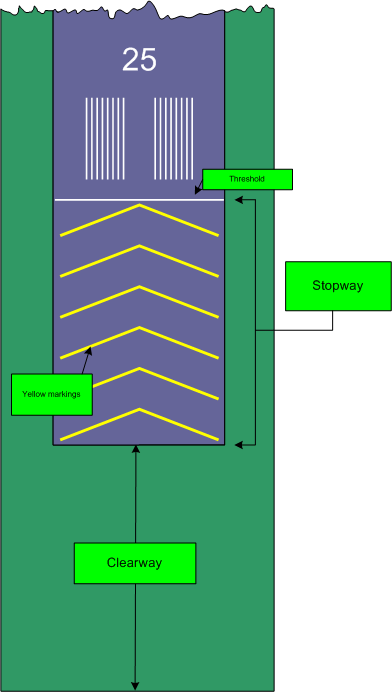
- Accelerate-Stop Distance Available (ASDA) is defined as the length of the takeoff run available plus the length of the stopway, where provided.
- A stopway is a rectangular area on the ground at the end of the runway, in the direction of takeoff, which is prepared as a suitable area in which an aeroplane can be stopped in the case of an abandoned take-off and is marked over the entire length with yellow chevrons (AIM AGA 3.6)
- Take-off Distance Available (TODA) is defined as the length of the takeoff run available plus the length of the clearway, where provided (to a maximum clearway distance of 1000’, all of which must lie within the airport boundary).
- A clearway is a rectangular area on the ground or water under the control of the airport authority, selected or prepared as a suitable area over which an aeroplane may make a portion of its initial climb to a specified height (AIM AGA 3.7).
- Take-off Run Available (TORA) is defined as the length of the runway declared available and suitable for the ground run of an aeroplane taking off.
No person may conduct a take-off in a Commuter aircraft when the weight of the aircraft exceeds the maximum take-off weight specified in the Pilot Operating Handbook given current pressure altitude and ambient temperature, and the landing at the planned destination airport and alternate airport exceeds the landing weight specified in the Pilot Operating Handbook, given anticipated pressure altitude and ambient temperature (CAR 704.46).
In determining the maximum take-off weight above, the following rules apply
- the required accelerate-stop distance (ASD) shall not exceed the accelerate-stop distance available (ASDA),
- the all-engines-operating take-off distance shall not exceed the take-off distance available (TODA),
- the required take-off run shall not exceed the take-off runway available (TORA).
Additionally, for the purpose of determining maximum take-off weight, the following factors shall be taken into consideration:
- pressure altitude;
- ambient temperature;
- the runway slope in the direction of the take-off; and
- not more than 50% of the reported headwind component or not less than 150% of the reported tailwind component.
Addtional Readings on Takeoff Performance: FAA's Pilot Guide to Takeoff Safety
En route Limitations with One Engine Inoperative (CAR 704.48)
No person shall operate a multi-engine aircraft with passengers on board if the weight of the aircraft is greater than the weight that will allow, in the event of any one engine becoming inoperative, the following altitudes:
-
- when operating IMC or in IFR flight on airways or air routes, the MOCA of the route to be flown;
- when operating IMC or night VFR flight along routes established by an air operator, the MOCA of the route to be flown; and
- when operating in VFR flight, at least 500’ above the surface.
Aircraft Equipment Requirements (CAR 704.62)
No person shall operate in IMC unless the aircraft is equipped with the following:
-
- two generators, each of which is driven by a separate engine;
- two independent sources of energy and a means of selecting either source, at least one of which is a engine-driven pump or generator, and each of which is able to drive all gyroscopic instruments and is installed so that the failure of one instrument or one source of energy will affect neither the energy supply to the remaining instrument nor the other source of energy.
- at least one landing light.
Protective Breathing Equipment
No air operator shall operate a pressurized aircraft unless protective breathing equipment with a 15-minute supply of breathing gas at a pressure-altitude of 8000’ is readily available at each flight crewmember position (CAR 704.66).
Hand-Held Fire Extinguisher
No air operator shall operate an aircraft with passengers on board unless at least one hand-held fire extinguisheris readily accessible for immediate use and is located in the passenger compartment (CAR 704.83).
Minimum Crew (CAR 704.106)
No air operator shall operate an aircraft with fewer than two pilots, where
- the aircraft is an aeroplane carrying 10 or more passengers;
- or is carrying passengers and is being operated in IFR flight.
Flight Crewmember Qualifications (CAR 704.108)
No person may act as flight crewmember unless:
- the person holds the licence and ratings required by Part IV (Personal Licensing);
- within the previous 90 days the person has completed at least three takeoffs and three landings
- where a type rating for that aircraft is required, in the same type or in an approved simulator, or
- where a type rating is not required, in that category and class or in an approved simulator;
- the person has successfully completed a pilot proficiency check, the validity period of which has not expired;
- has fulfilled the requirements of the air operator’s ground and flight training program.
No person shall act as the Pilot-in-command of an aircraft with passengers on board in IFR flight unless that person has acquired at least 1200 hours of flight time as a pilot.
No person shall act as the Pilot-in-command of an aircraft in VFR flight unless that person has acquired at least 500 hours of flight time as a pilot.
No person shall act as the Pilot-in-command of an aircraft with persons other than a flight crewmember on board in night VFR unless that person holds an instrument rating for that class of aircraft.
If the aircraft is operated on a training, ferry or positioning flight, or when authorized in the operating certificate, a flight crewmember does not require 90-day landing and take-off currency, or completion of the air operator’s ground and flight training program.
Qualifications Validity Period
The validity period for pilot proficiency checkand annual training is 12 months (identical to the renewal format of medical certificates) (CAR 704.111).
If the proficiency check or annual training is renewed within the last 90 days of its validity period, the validity period is extended 12 months.
If not renewed within 24 months of expired validity, the person must re-qualify.
Commuter Operations Pilot Proficiency Check (PPC)
Note: the material below is for information purposes only and does not constitute part of the material required for student knowledge.
- Pre-flight Phase
- Flight Planning and Equipment Examination
- flight planning shall include a practical examination on the pilot's knowledge of standard operating procedures and the Aeroplane Flight Manual including performance charts, loading, weight and balance and Flight Manual Supplements; and
- the equipment examination shall show a practical knowledge of the airframe, engine, major components and systems including the normal, abnormal, and emergency operating procedures and limitations relating thereto.
- Aeroplane Inspection
- Flight Planning and Equipment Examination
- A pre-flight aeroplane inspection that includes:
- a visual inspection of the exterior and interior of the aeroplane, locating each item to be inspected and explaining the purpose of the inspection;
- the proper use of the pre-start, start and pre-taxi check lists; and
- checks of the appropriate radio communications, navigation and electronic equipment and selection of the appropriate communications and navigation frequencies prior to flight.
- Flight Phase
- Taxiing
- taxiing procedures;
- a taxiing check including:
- the use of the taxiing check list;
- taxiing in compliance with clearances and instructions issued by the appropriate air traffic control unit or by the person conducting the pilot proficiency check; and
- where a second-in-command is undergoing the pilot proficiency check, the taxiing check outlined above to the extent practicable from the second-in-command position.
- Engine Checks
- Taxiing
Engine checks shall be conducted as appropriate to the aeroplane type.
- Take-off
- One normal take-off to be performed in accordance with the Airplane Flight Manual or where the aeroplane is a turbo-jet, a noise abatement take-off performed in accordance with the Airplane Flight Manual (where applicable) and the Canada Air Pilot.
- An instrument take-off performed in the same manner as the normal take-off except that instrument flight rules are simulated at or before reaching an altitude of 200 feet above the airport elevation. Not required to be demonstrated where the Air Operator's Certificate authorizes operations under day VFR only, or the air operator assigns the pilot to day VFR flight only.
- Where practicable under existing meteorological, airport or airport traffic conditions, one crosswind take-off performed in accordance with the aeroplane operating manual where applicable.
NOTE: Any or all of the above take-offs may be combined.
- a simulated engine failure after take-off at a safe altitude as close to V2 as is safe and appropriate to the aeroplane type under the prevailing conditions, or if V speeds are not published in the Aeroplane Flight Manual, as close to the take-off safety speed as is safe and appropriate to the aeroplane type under the prevailing conditions.
- a rejected take-off explained by the candidate prior to the flight.
- Instrument Procedures
Except where an Air Operator Certificate authorizes operations under day VFR only, or the air operator assigns the pilot to day VFR flights only instrument procedures shall consist of IFR pre-flight preparation, departure and en route procedures, terminal procedures and system malfunctions:
- an area departure and an area arrival procedure shall be performed where the pilot:
- adheres to actual or simulated air traffic control clearances and instructions; and
- properly uses the available navigation facilities;
- a holding procedure;
- at least two instrument approaches performed in accordance with procedures and limitations in the Canada Air Pilot or the equivalent foreign publication, or approved company approach procedure for the approach facility used. Where practicable one of the approaches shall be a precision approach and one a non-precision approach; and
- a circling approach, where the air operator is authorized for circling minima below ceiling 1000 feet and 3 miles ground visibility, except where local conditions beyond the control of the pilot prevent a circling approach from being performed;
- In Flight Manoeuvres
- at least one steep turn in each direction with a bank angle of 45º and a change in heading of at least 180° but not more than 360°;
- Approaches to stalls
For the purpose of this manoeuvre the required approach to a stall is reached when there is a perceptible buffet or other response to the initial stall entry. When performed in an aeroplane the approach to stalls shall be conducted at an altitude of at least 5000 feet AGL, and if conducted above cloud at an altitude of at least 2000 feet above the cloud tops.
The following approaches to the stall are required during initial and upgrade PPCs:
- one in the take-off configuration, except where a zero-flap take-off configuration is normally used in that model and type of aeroplane;
- one in a clean configuration; and
- one in a landing configuration.
One of the approaches to stall may be performed while in a turn with a bank angle of between 15° and 30°;
- Landings and Approaches to Landings
- one normal landing which shall, where practicable, be conducted without external or internal glideslope information;
- one landing from an instrument approach, and where prevailing conditions prevent an actual landing, an approach to a point where a landing could have been made. Not required to be demonstrated where the Air Operator’s Certificate authorizes operations under day VFR only, or the air operator assigns the pilot to day VFR flights only;
- one cross wind landing where practicable under existing meteorological, airport and airport traffic conditions;
- one landing and manoeuvring to that landing with a simulated failure of 50 percent of the available engines which shall be on one side of the aeroplane for the pilot-in-command and on outboard engine only for other than the pilot-in-command. Where the aeroplane type is a three-engine aeroplane, the loss of power shall be an outboard engine and the centre engine for the pilot-in-command and on outboard engine for other than the pilot-in-command. For three and four-engine aeroplanes the pilot in command is required to perform a two-engine inoperative procedure during initial qualification check and annually thereafter; or
- one landing under simulated circling approach conditions except that where prevailing conditions prevent a landing, an approach to a point where a landing could have been made.
NOTE: Any of the landings and approaches to landings specified in this section may be combined. A minimum of two landings is required.
- Normal Procedures
The crew shall demonstrate use of as many of the air operator's approved Standard Operating Procedures, and normal procedures as is necessary to confirm that the crew has the knowledge and ability to properly use installed equipment, (auto-pilot and hand flown manoeuvres as appropriate).
- Abnormal and Emergency Procedures
- The crew shall demonstrate use of as many of the air operator's approved Standard Operating Procedures and abnormal and emergency procedures for as many of the emergency situations as is necessary to confirm that the crew has an adequate knowledge and ability to perform these procedures.
- System malfunctions shall consist of a selection adequate to determine that the crew has satisfactory knowledge and ability to safely handle malfunctions.
- At least two simulated engine failures any time during the check.
Briefing of Passengers (Air Taxi and Commuter Operations)
The Pilot-in-command must ensure that all passengers are provided with a safety briefing (CAR 703.39[1-5] and 704.34[1, 2, 4, 5]).
The briefing shall consist of an oral briefing provided by a flight crewmember, or by audio or audio-visual means, and shall include the following information:
Prior to take-off:
- where, when, and how carry-on baggage is required to be stowed
- the fastening and unfastening, adjusting and general use of safety belts;
- when the seat backs must be secured upright and tables stowed;
- the location of emergency exits (including instructions to persons sitting next to an exit on how the exit operates);
- location, purpose, and advisability of reading safety feature Cards;
- the regulatory requirement to obey crew instructions regarding seat belts and no smoking (or the location of fasten seat belts and no smoking signs);
- the location of emergency equipment such as ELT, fire extinguisher, survival equipment, first aid kit and life raft;
- the use of passenger operated portable electronic devices;
- the location of fixed passenger oxygen systems, including the location and presentation of masks, activation of the flow of oxygen, and instruction on how to correctly don and secure the mask (this must include a demonstration) and the priority for persons assisting others;
- the location and use of life preservers (demonstration required) and instruction on how and when to inflate life preservers.
After take-off, if not included in the pre-take-off briefing: that smoking is prohibited and the advisability of continued use of seat belts.
In-flight owing to turbulence: the requirement to wear seat belts and stow baggage.
Prior to passenger disembarkment:
- the safest direction and most hazard-free route for passengers to move away from the aeroplane;
- the danger and location of aircraft hazards such as pitot tube, propellers, or engine intakes.
Where no additional passengers have embarked the flight for subsequent takeoffs on the same day, the pre-take-off and post take-off briefings may be omitted provided a crewmember has determined that all carry-on baggage is stored, seat belts are secured, and seat backs and tables are properly secured.
Where a standard briefing is ineffective owing to a person’s physical, sensory or comprehension limitations, or because a passenger is responsible for another person on board, the Pilot-in-command shall ensure the subject person is provided with an individual safety briefing that is appropriate to the person’s needs.
Items to be included in individual safety briefings for mobility restricted passengers, visually impaired, comprehension restricted, hearing impaired, and persons with infants are specified in CAR 723.39 (they are logical and practical).
The air operator must insure that each passenger is provided with safety information.
In the event of an emergency and where time and circumstances permit, the Pilot-in-command shall ensure that all passengers are provided with an emergency briefing.
The Pilot-in-command must ensure that each passenger seated next to an emergency exit is made aware of how to operate that exit.
Maximum Duty and Flight Times
Maximum Flight Time (CAR 700.15)
Flight time is defined as beginning from the moment an aircraft first moves under its own power for the purpose of taking off until the moment it comes to rest at the end of the flight.
The maximum flight time for a crewmember is 1200 hours in any 365 consecutive days, 300 hours in any 90 consecutive days, and 120 hours in any 30 consecutive days.
If the flight is conducted under Subpart 4 (Commuter Operations) or Subpart 5 (Airline Operations) using an aircraft other than a helicopter, the maximum flight time within 7 consecutive days is 40 hours.
If the flight is conducted under Subpart 2 (Aerial Work, meaning “product dispersal” or “object towing”) or Subpart 3 (Air Taxi Operations), the maximum flight time within 7 consecutive days is 60 hours.
If the crewmember conducts single-pilot IFR flight, the maximum flight time within 24 hours is 8 hours.
These maximum flight times can be increased where the increase is authorized in the air operator certificate.
A person who reaches the maximum is deemed to be fatigued.
Flight Duty Time Limitations and Rest Periods (CAR 700.16)
Flight duty time is defined as a period of time that starts when a flight crewmember reports for a flight, or reports as a flight crewmember on standby, and ends with “engines off” at the end of the final flight. However, if the flight is conducted under Subpart 4 (Commuter) or Subpart 5 (Airline), the end of flight duty time is defined as 15 minutes after “engines off” at the end of the final flight, and also includes the time required to complete any assigned duties prior or following a flight.
Flight crewmember on standby denotes a flight crewmember who has been designated by an operator to remain at a specified location in order to be available to report for flight duty on notice of one hour or less.
Flight duty time shall not exceed 14 consecutive hours in any 24 consecutive-hour period.
Where a flight crewmember is faced with three flight duty time assignments that exceed 12 consecutive hours each, that person shall receive at least 24 consecutive hours free from flight duty between each of those flight duty time assignment.
Air operators must provide the minimum rest period and flight crewmembers must use the rest period for rest and must be adequately rested prior to reporting for flight duty.
Where flight duty time includes a rest period, flight duty time may be extended beyond the maximum flight duty time by one-half the length of the rest period to a maximum of 3 hours provided the following conditions are met:
- the flight crewmember is provided with advance notice of the extension of flight duty time;
- the flight crewmember is provided with a rest period of at least 4 consecutive hours in suitable accommodation; and
- the minimum rest period following the flight duty time assignment is increased by an amount at least equal to the extension.
Flight duty times may be increased if there are provisions in the air operator certificate.